Cooling Water Pipeline Internal Coating
Industry: Power (POWR)
Application: VPF-Valves, Pipes and Fittings (VPF)
Substrate: Carbon steel
Customer Location: Ratchaburi, Thailand
Application Date:
Products: Belzona 1341 (Supermetalglide),Belzona 5811 (Immersion Grade)
Problem: The client experienced severe internal corrosion within the cooling water pipeline system due to failure of the previously applied antifouling paint and epoxy coating. The existing coating system exhibited poor adhesion performance and began to peel off after approximately 3 years of service,
particularly in high-turbulence areas such as elbows, reducers, risers, and beneath the condenser waterbox sections, where flow velocity and turbulence are significantly higher.
In addition, extensive coating disbondment was observed at welding joints. During plant construction, field welding activities were carried out after the original coating application, requiring localized coating touch-up at the weld areas. However, the touch-up process was performed without proper abrasive blasting or adequate surface preparation, resulting in an insufficient surface profile and poor mechanical adhesion between the substrate and the coating system.
Consequently, premature coating delamination and under-film corrosion developed at these locations during operation.
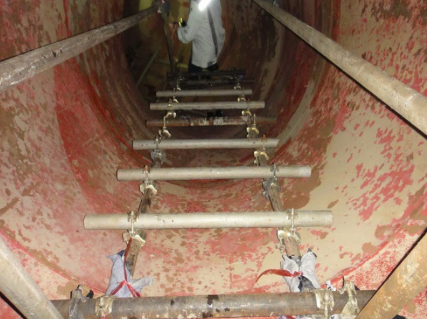
Grit blasting was completed before the coating application
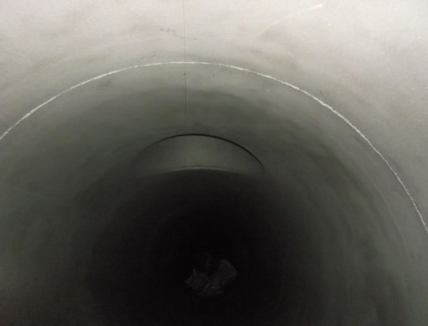
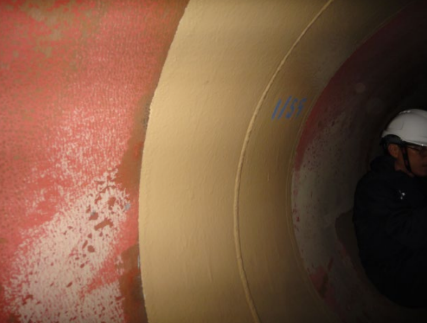
Coating application in progress
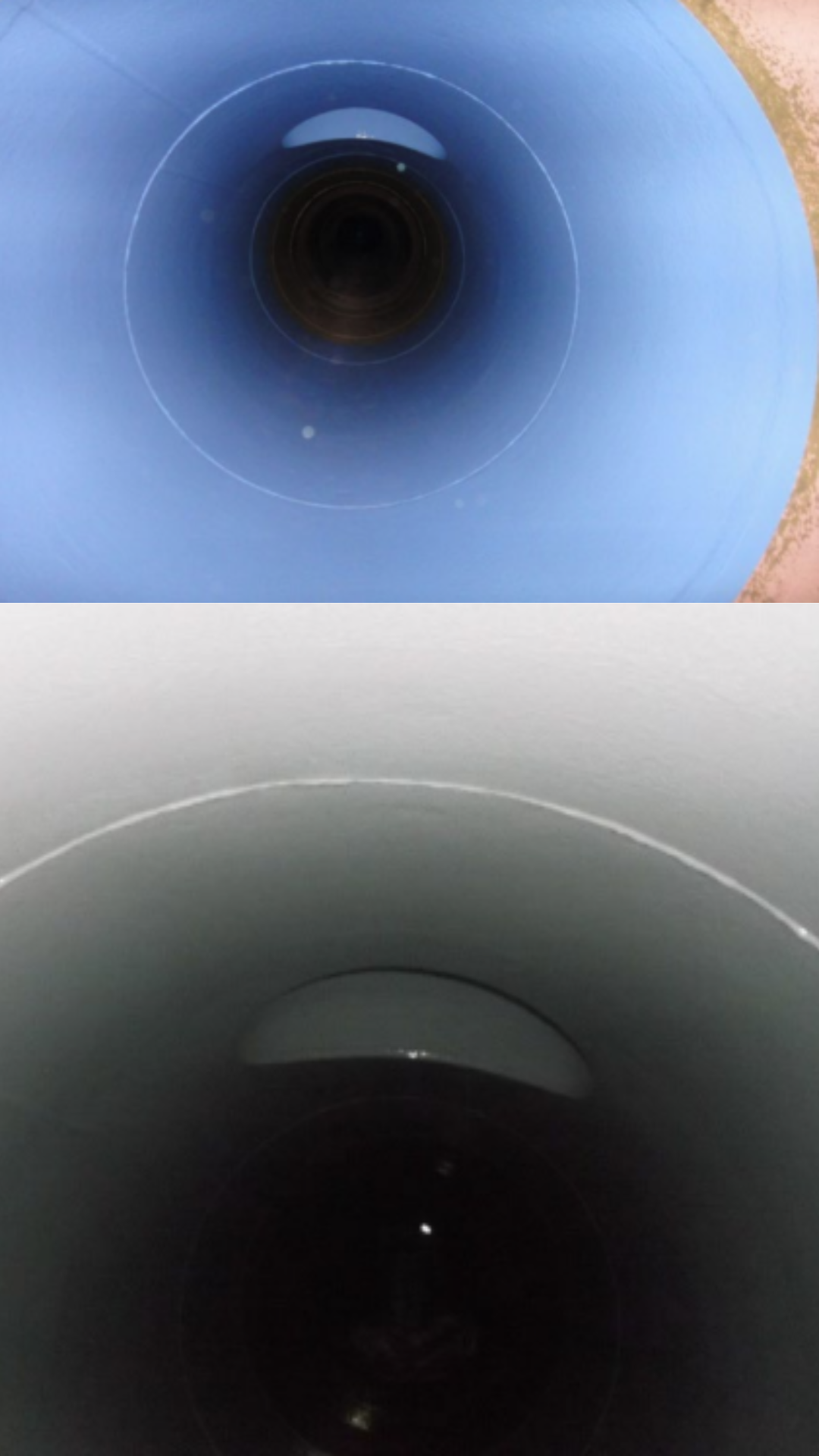
Completed coating application of Belzona 1341 (Top) and Belzona 5811 (Bottom)
Application Situation
The power plant has scheduled a major maintenance shutdown every three years.
During each shutdown period, the plant plans to carry out inspection, repair, and coating rehabilitation work progressively along the
cooling water pipeline system to maintain long-term corrosion protection and operational reliability.
Belzona 5811 (Immersion Grade) was specified for laminar flow areas such as straight pipe sections and welding joint areas, where excellent corrosion resistance and high adhesion are required.
For high turbulence and high erosion-corrosion zones such as elbows, reducers and risers, Belzona 1341 (Supermetalglide) was specified due to its superior erosion resistance, smooth hydrophobic surface, and enhanced flow efficiency performance.
Application Method
1. Prior to surface preparation, all internal pipeline surfaces were inspected to identify areas affected by corrosion, coating disbondment, pitting, and erosion damage. The existing failed antifouling epoxy coating was completely removed from the substrate surface.
2. All carbon steel surfaces were abrasive blasted using copper slag abrasive to achieve a surface cleanliness of Sa 2.5 in accordance with ISO 8501-1. Surface profile was maintained at approximately 75 microns to provide adequate mechanical anchorage for the coating system.
3. Check for salt contamination at surface. Special attention was given to welding joints, elbows, reducers, risers, and under condenser waterbox areas due to the severe turbulence and previous coating failures found in these locations.
4. All sharp edges and weld spatters were ground smooth prior to blasting to reduce stress concentration and improve coating continuity.
5. After blasting, all surfaces were cleaned using compressed dry air and vacuum cleaning to remove dust, abrasive residues, salts, and other contaminants. Surface cleanliness, profile depth, and environmental conditions including substrate temperature, air temperature, relative humidity, and dew point were verified before coating application.
6. Belzona 5811 (Immersion Grade) was applied to laminar flow areas such as straight pipe sections and welding joint areas. The material was applied by brush and roller equipment to achieve the specified dry film thickness according to the project specification. For severe service turbulent flow areas including elbows, reducers and risers, Belzona 1341 (Supermetalglide) was applied due to its superior erosion-corrosion resistance and smooth hydrophobic surface characteristics. The coating was carefully applied to obtain a smooth finish without pinholes, sagging, or surface defects that could affect flow performance.
7. Stripe coating was performed on weld seams, corners, edges, and geometrically difficult areas prior to full coating application to ensure adequate coating coverage and film build.
8. Holiday testing was conducted on the completed coating system to identify any pinholes, discontinuities, or coating defects. Visual inspection was also performed to confirm coating uniformity, adhesion quality, and surface finish condition.
Belzona Facts
From an application perspective, the Belzona repair and protection system can be applied on-site during planned maintenance shutdowns without requiring major equipment replacement, significantly reducing downtime and overall repair costs. The combination of proven performance, engineered material selection, long-term reliability, and practical field application support was a key factor in securing customer confidence.