Downloading PDFs

Please wait while your PDF(s) download.
Please wait while your PDF(s) download.

KHIA ID: 10081Industry: Steel & Metal Processing (STEL)
Application: SHM-Solids Handling Machinery (SHM)
Substrate: ConcreteCustomer Location: Glenbrook, New Zealand
Application Date: November 2025Products: Belzona 1321 (Ceramic S-Metal),Belzona 1812 (Ceramic Carbide FP),Belzona 4151 (Magma-Quartz Resin)
Problem: The sluice is located directly beneath the conveyor along which the steel slab moves as it leaves the ovens during hot rolling. During this process, impurities known as beards flake off and fall into the sluice, where they are carried away. These beards, along with smaller particulates, are extremely abrasive and gradually wear grooves into the sluice walls. These grooves trap the beards, creating dams that block the flow.
Removing these dams manually with pitchforks is both dangerous and time-consuming. Belzona’s Authorized Distributor in New Zealand, Reptech Corporation, was tasked with providing an abrasion-resistant lining capable of withstanding the aggressive service conditions and preventing the buildup of beards.
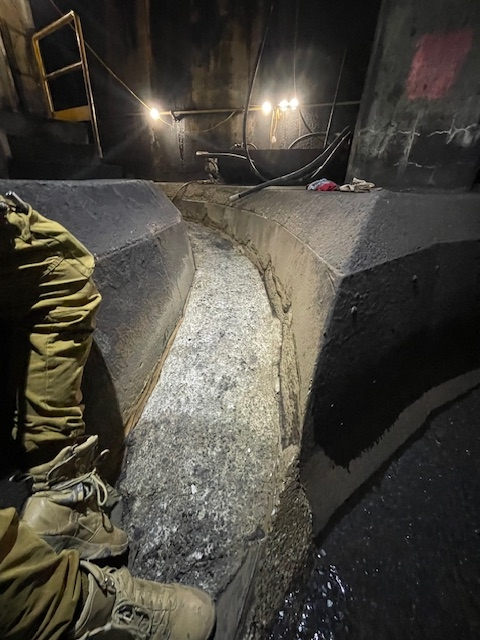
The condition of the concrete after the sluice had been drained and cleared of beards and grit.
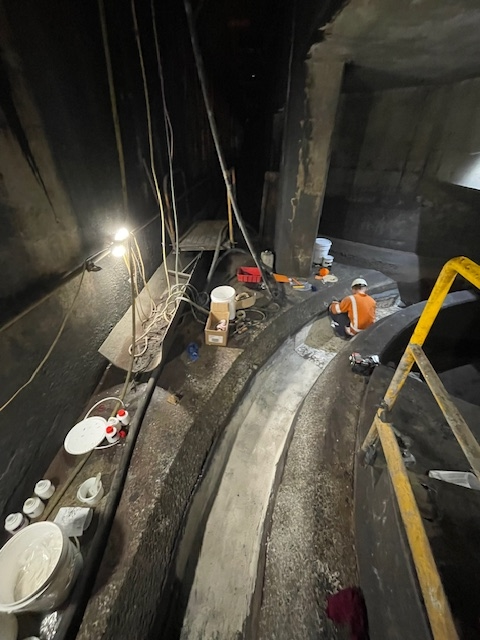
The channel was rebuilt using Belzona 4151 (Magma Quartz Resins) and locally sourced fine quartz sand and then lined with alumina tiles using Belzona 1321 (Ceramic S-Metal) as the adhesive.
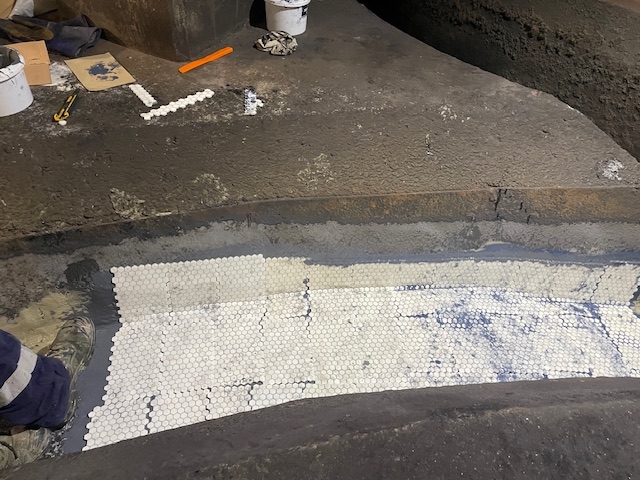
Once the Belzona 1321 (Ceramic S-Metal) had cured, the fabric backing was removed, and the area was frost-blasted in preparation for grouting with Belzona 1812 (Ceramic Carbide FP).
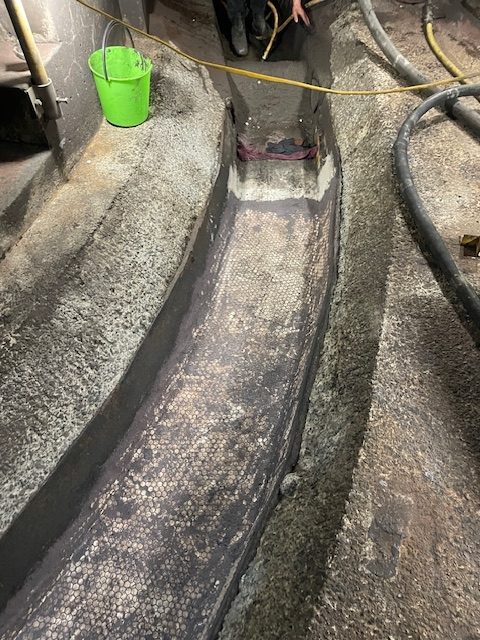
The Belzona system exhibits virtually no wear after 3 months of service in this particularly aggressive environment and the customer has now asked us to complete an additional 20 meters of sluice for them.